A glimpse of the studio
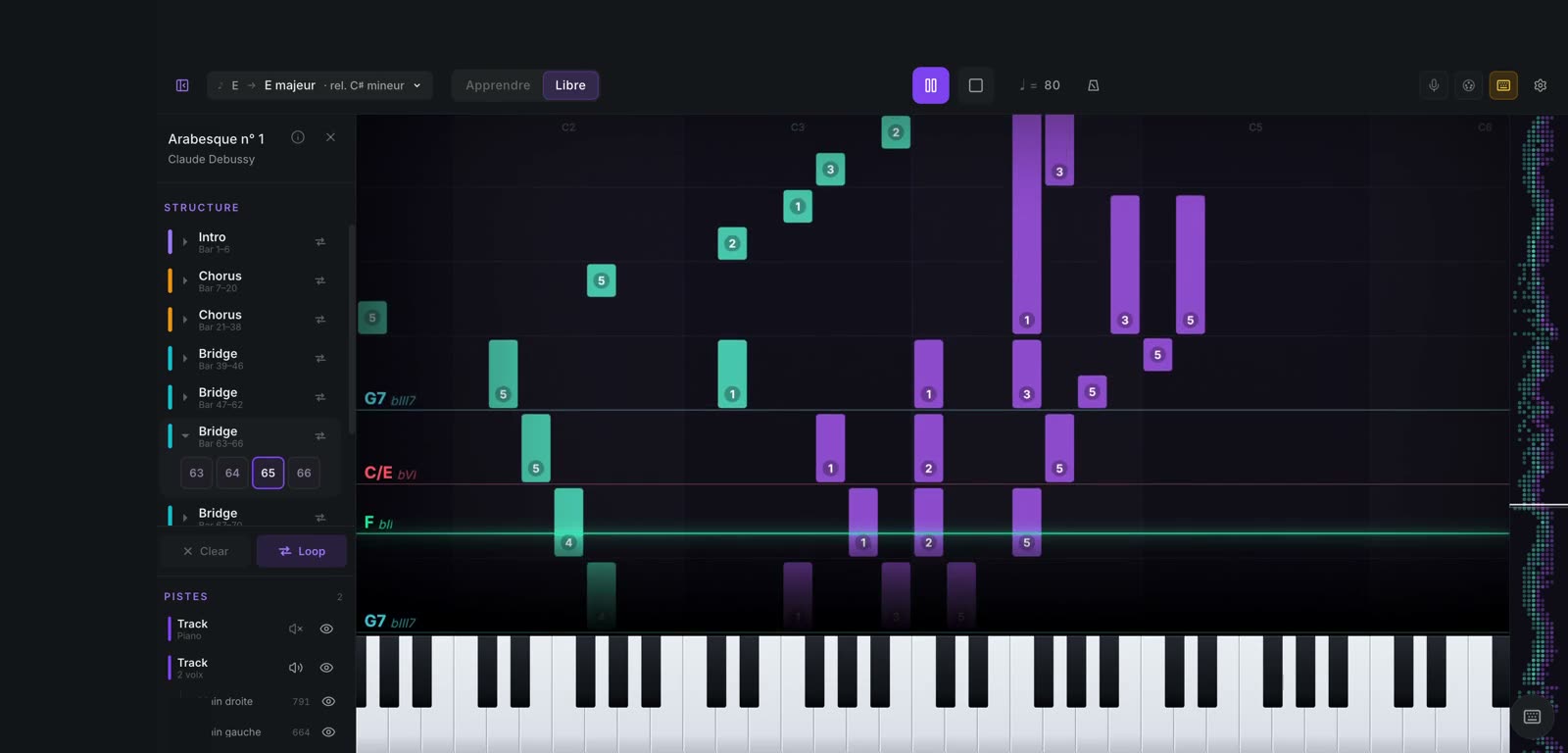
Debussy, Arabesque no. 1. The rest is inside.
Two paths
The Method
One piece, two ways in. You pick when you open it, and you can cross over at any time. On both, every note is named and every chord is named, right over the piano roll: you never wonder what you are playing.
The harmonic path
You learn the piece through what holds it up, its chords. Several steps, built from your own score: at every one you play the real piece, stripped back, never an exercise written for you.
- 01Chordsthree notes, pressed together
- 02Inversionsthe same harmony, closer to the hand
- 03Rhythmthe chord takes its place in the beat
- 04The notes come backstep after step, up to the score
The note path
You learn the notes of the piece, phrase by phrase, hand after hand, until it holds under your fingers. The score exactly as written, from the first move up to full speed.
- 01Presentationthe chord, named
- 02Left handnote by note
- 03Right handnote by note
- 04Both handsthen in rhythm
- 05Chainingonto the phrase before
- 06Tempo60% to full speed
On stage
Play for someone. Play with someone.
The studio is no longer only a place to practice alone. You can give a recital there, record yourself, or invite other pianists in.
The recital
Your audience sees your notes and your hands
Your notes fall on every viewer's roll the moment you play them, and each viewer's studio plays them. Your camera shows your hands above the keyboard, in step with the notes.
- A webcam, or your phone, paired with a QR code
- Public with a link to share, or private with a code
- No account needed to watch
Recording
Every run becomes a take
One button, and you play with no audience. You watch yourself back in the studio, notes and cameras included, then publish the take you keep.
- Each take analyzed like any piece: chords, hands, fingering
- Take it with you as a MIDI file
- Watch it back on your phone too
Together
Live, without the lag
Invite someone: they type your code and you play together. Everyone hears themselves instantly, and the others' notes land on the same grid as yours.
- The network delay, measured and set for the whole room, all the time
- A six-character code to join
- Who is there and their latency, in plain sight
What you can do
Harmonic analysis
Chords, scale degrees and key, shown as you play.
Automatic hand detection
Drop in a MIDI file and Virtuosa works out, note by note, which hand plays what.
Sections and loops
Spot the intro, the chorus, the bridge. Loop the bar that trips you up.
No sheet music
A readable piano roll, with fingering on every note.
Your own pieces
Import any MIDI file and start working on it.
Guided programs
Chords, arpeggios, scales, rhythm, hand coordination.
The analyzer
Any piece, decoded in under 2 seconds
A MIDI file contains no chords. It contains notes, and the moment each one sounds. The chords, the hands, the key, the fingering: everything you see over the piano roll is worked out by the analyzer. So we measure it against scores annotated by musicians, and publish the numbers here, including the ones that are not flattering.
At every instant, the analyzer looks for the most coherent musical reading of what is played. It separates the notes of the chord from the passing notes, weighs the bass, the bar and the key, and recognizes the motifs that come back, which is how it recovers the structure of the piece.
It does the same work for the hands and the fingering: it works out which hand plays each note, then looks for a fingering that holds together with the position of the hand, the shifts, and what comes before and after. The result is not a sequence of notes: it is a reading of the piece, ready to learn from.
How often the analyzer gets it right, and how fast. Next to every figure, the sample it was measured on.
- 89.2%
- the chord is built on the right note400 pieces, multi-track
- 74.7%
- and its exact name, minor or seventh includedsame sample
- 93.6%
- when the chord changes on screen, it really changedsame sample
- 92.0%
- every note on the correct hand288,295 annotated notes
- 99.97%
- a fingering the hand can actually hold138,181 notes, solo piano
- 90.0%
- the right key for the piece650 annotated scores
- 99.5%
- of the piece carries a chord name, no gaps400 pieces
- 1.4 s
- to analyze a whole piece: chords, hands and fingeringmedian time
MIDI gives the notes. Virtuosa finds the music behind them.
Two professional musicians cutting the same piece into phrases agree only 86.7% of the time, and two professional pianists put the same fingers on only 71.4% of the notes. Those ceilings are what we aim at, not 100%. On fingering there is no single right answer but several plausible ones, so what is measured here is that none of them asks the hand for the impossible, on solo piano, orchestral transcriptions counted separately.
Sit down at the keyboard.
Alone, for an audience, or together. The beta is open to everyone, right now.
No sign-up, no install. MIDI keyboard or your computer's.